
What’s Pluto made of?
The diverse chemical compositions we’ve seen on Pluto are giving us some important clues to understanding Pluto’s geological history and climate.

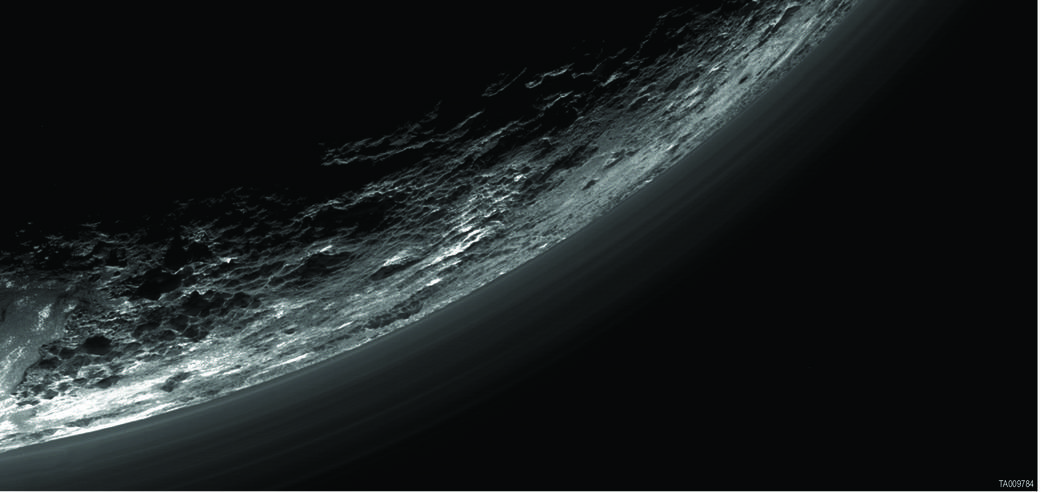
The high-resolution images from the New Horizons cameras show diverse ice reservoirs across Pluto’s surface. By studying the reflected spectra from the surface, we’ve identified several different types of ices: in particular, nitrogen, methane and carbon monoxide. The locations and characteristics of these ice reservoirs mean that there have been long epochs of ice transport across the dwarf planet’s surface.
A darker veneer on top of the ices is probably tholin material – organic compounds processed by solar radiation. These are produced slowly in Pluto’s atmosphere and gently rain down, even now, onto the surface. An enormous darker region, informally named Cthulhu Regio, has a meters-thick layer of this organic tholin material that has built up over billions of years. Frozen water is one of the strongest solids at the low temperatures we see on Pluto. We believe that the ice mountains that extend several miles above the surface are made of water ice – the biggest ice cubes in the solar system.
Charon, too, had some major surprises in store for us. Pluto’s largest moon has an extended equatorial region of smooth plains that may also be due to material that erupted from Charon’s interior via ice volcanoes that then flowed over its surface about four billion years ago. We suspect that was when Charon’s subsurface water ocean froze, causing global fractures as the moon expanded in size (water expands when it freezes).
Charon has dark poles that may be related to volatile gases that escaped from Pluto’s atmosphere only to be captured by the moon’s cold poles. These gases trigger chemical reactions on the surface that, we believe, produce the darker color of the poles.
[Explore how Pluto’s atmosphere works next…]
[nextpagelink][/nextpagelink]